How States Can Improve Medicaid Provider Satisfaction
Complex regulatory requirements and outdated systems force providers to spend an increasing share of time navigating documentation rather than delivering care. And, with new CMS requirements around provider revalidation, administrative burden is going to increase for providers and state agencies. This burden can lead to provider friction, a structural barrier that directly affects access, continuity, and network stability across state Medicaid programs.
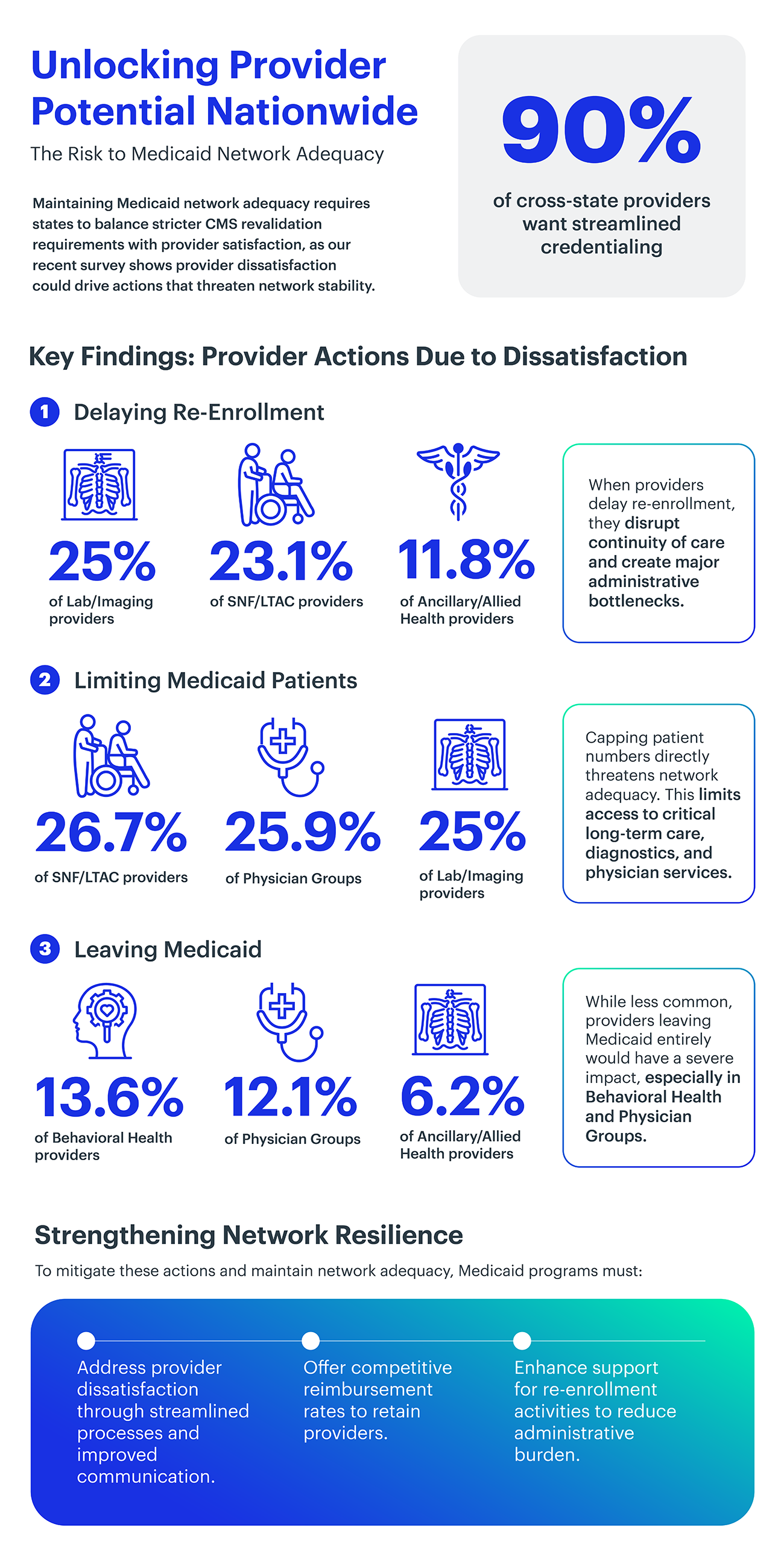
In a recent provider survey sponsored by Gainwell, nearly one-third of providers reported significant dissatisfaction with Medicaid administrative processes. Those dissatisfied providers are 3.9X more likely to leave Medicaid entirely and 2.5X more likely to cap the number of Medicaid patients they see.
States can change this trajectory by making it easier for providers to work within Medicaid. When agencies reduce administrative burden and simplify key processes, they give providers more time to focus on patient care, which strengthens participation, and supports more resilient networks.
What Do Providers Want State Medicaid Agencies to Prioritize?
Despite improvements in technology, providers still seem to be buried in administrative work, often due to a lack of data sharing across systems. Even modern systems are less useful if critical data is stuck in silos.
Providers overburdened by administrative work are more prone to limit their Medicaid involvement, stretching already thin networks even thinner. To reverse this trend, states must shift their focus to modern, innovative workflows that promote the sharing of provider data across systems, and even state lines.
Based on provider feedback, there are three clear priorities for states when it comes to technology investments.
Streamlined Credentialing
Fragmented credentialing is a major source of inefficiency for modern healthcare practices. According to survey results, 72% of providers stated that a single application to enroll with all managed care organizations (MCOs) and the state Medicaid agency would significantly improve their experience. Providers are looking for consolidated workflows that automatically pull data from primary sources, such as medical boards, rather than requiring them to upload and re-verify documents multiple times.
24/7 Claim Status Tracking
Providers are seeking the same level of digital visibility in healthcare as they experience in other digital transactions. The survey indicates that 68% of providers identified 24/7 claim status tracking as a significant improvement they want states to prioritize. The ability to check claim statuses online at any time allows medical practices to manage their accounts receivable efficiently without waiting on hold with customer service
Faster Enrollment
Every day an application sits as pending is a day a qualified provider cannot see a Medicaid patient. Speed is critical, with 68% of providers calling for faster enrollment approval times. State Medicaid agencies can accelerate this timeline by automating license and background data verification. And the proof is in the numbers. Providers in states with modernized, integrated enrollment systems are 50% more satisfied than those navigating legacy systems.
Next Steps for Building Resilient Medicaid Provider Networks
State agencies can strengthen provider satisfaction and protect network stability by taking a clear, phased approach to administrative modernization:
- Identify where friction slows providers down most. Review the enrollment, credentialing, prior authorization, and claims experience from the provider’s point of view. Look for repeat data entry, manual reviews, long approval times, and handoffs between disconnected systems.
- Prioritize workflows that have the biggest impact on participation. Focus first on processes that delay provider enrollment, create claim uncertainty, or increase staff burden for high-volume and high-need provider groups. A targeted plan will help states move faster and show value sooner.
- Use automation to remove avoidable manual work. Automate license checks, primary source verification, background reviews, and routine status updates where appropriate. This shortens timelines, improves accuracy, and frees staff to focus on exceptions and support.
- Replace fragmented processes with more streamlined paths for enrollment, credentialing, and status tracking. When providers can submit information once, track progress in real time, and avoid duplicate requests, agencies reduce burden and build trust.
- Strengthen data sharing across systems and partners. Connect provider data across MCOs and core Medicaid platforms so information moves with less delay and rework. Better interoperability supports faster decisions and a more consistent provider experience.
- Measure results and keep improving. Track enrollment turnaround times, provider satisfaction rates, abandonment points, call volume, and participation trends. Use that data to refine workflows, address pain points, and make steady progress toward a simpler provider experience.
Administrative modernization is not just an operational upgrade. It is a practical way to help providers stay engaged, expand access, and support better outcomes for those who rely on Medicaid.
For a deeper look at survey findings, the risks of administrative friction, and actions states can take now, read the full white paper: The Silent Barrier to Medicaid Care Access – Provider Administrative Friction | Gainwell